Subscribe to Podcast
 Newsletters
Is Today's France Tomorrow's USA?
Kevin McCullough
Mon, Oct 19, 2026
By Kevin McCullough, Townhall.com
Europe has a problem, and it isn't subtle anymore.
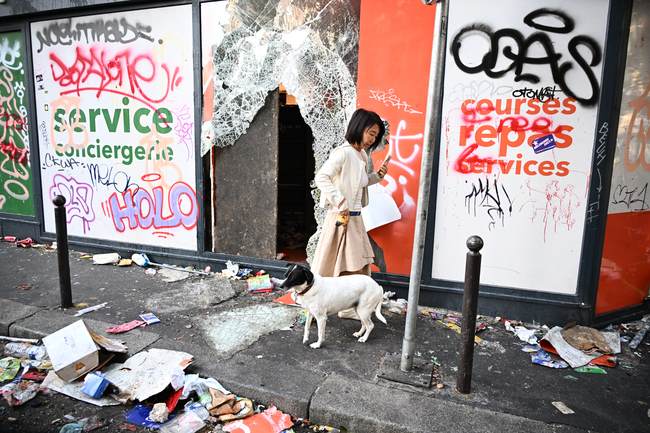
What began weeks ago in France as student demonstrations over declining public services, cost-of-living pressures, and a weak national economy has metastasized into something else entirely. Nearly 1,000 French police officers injured. Roughly 2,400 people arrested. The Federation of Trade and Retail says close to 3,000 stores were hit by vandalism and looting in Paris, Marseille, and beyond. France deployed 60,000 police and security personnel just to manage Saturday's unrest. Marseille banned demonstrations outright. Unions have now called for nationwide strikes on November 5, and multiple European governments are warning their own citizens to avoid crowds and exercise caution inside France. Caution. Inside France. That's where we are.
Prime Minister Sébastien Lecornu has placed the blame squarely on "ultra-left radical groups," accusing them of manufacturing "profound unrest" deliberately, ahead of France's presidential election. President Macron rejected his interior minister's offer to resign but conceded there were real "intelligence and foresight failings" inside his own government — an admission, buried in diplomatic language, that nobody saw this coming until it was already burning.
And it isn't staying inside France's borders. Belgium erupted the same weekend — masked demonstrators clashing with riot police in Brussels, an overturned car, tear gas, bicycles burning near Brussels-South station. Belgium's interior minister said flatly that "what is unfolding in Brussels is no longer mere protest." More than 130 people have been arrested in Liège alone, and union-led strikes have already paralyzed Brussels transit, grounding over a hundred flights in a single day. Protesters told reporters they were directly inspired by what they'd watched happen in France.
President Trump weighed in Monday on Truth Social, and he didn't bother with diplomatic softening. "The migrants have taken over France," he wrote. "They must CLOSE THE BORDERS, FAST!"
He's not wrong, and the reason he's not wrong has nothing to do with any single protest or any single grievance. It has to do with what happens when a country stops controlling who crosses its borders and in what numbers, and then acts surprised when economic frustration, cultural strain, and imported ideological extremism all collide in the same city squares at the same time. France didn't get here overnight. It got here through years of policy choices that treated border enforcement as something slightly embarrassing to discuss in polite company. Now Paris looks like a country losing the argument over whose streets they actually are.
It doesn't stop at Belgium, either. Italy's "No Meloni Day" protests erupted across Milan, Turin, Bologna, Rome, and Bari starting October 16 — Milan alone logged 271 arrests by the second day, most of them minors. Lisbon saw tens of thousands march over Portugal's housing crisis, with demonstrators pitching dozens of tents downtown. Tirana has now held six straight days of protests demanding the Albanian prime minister's resignation. Five countries, one autumn, the same combination every time: real grievance, organized actors, and a match waiting to be struck.
So ask the obvious question: is today's France tomorrow's America?
Look at what's actually on the ballot here at home. Michigan's Senate race features Abdul El-Sayed, a candidate who has spent his campaign aligned with the DSA's platform — abolishing ICE, Medicare for All funded by math that no economist on the planet can actually make work, and a worldview that treats American border enforcement the same way France's political class treated its own for the last decade: as the problem, rather than as the baseline function of a functioning nation-state. El-Sayed isn't an outlier in his own party right now. He's the direction a meaningful share of it is actively moving, cheered on by sitting members of Congress who've built national followings doing exactly that.
Elect enough of that, and you don't get a gentler America. You get the French model, with a delay. Open borders don't produce the harmonious, borderless utopia the people selling the idea promise. They produce exactly what Paris is living through right now: economic strain compounding with unassimilated grievance, exploited by ideological actors — Lecornu's own government points the finger at the radical left specifically — until normal civic disagreement turns into officers hospitalized and shopkeepers boarding up their windows.
America First policies exist as the direct counterweight to that laissez-faire drift, and this is exactly the kind of moment that proves why. Controlled borders aren't about hostility toward immigrants who come here legally, assimilate, work, and build lives alongside the rest of us — millions have done exactly that and are part of the fabric of this country. Controlled borders are about refusing to let the sheer scale and pace of uncontrolled entry outrun a nation's ability to absorb, vet, and integrate the people crossing into it. France let that balance tip for years. Paris is now living with the bill.
Trump's advice — close the borders, fast — isn't an overreaction to a single ugly weekend in Paris. It's the lesson sitting in plain sight for any country watching closely enough to learn it before paying the same price. America has an election in three weeks that will decide, in part, whether we keep moving toward the border-enforcement model that's kept this kind of chaos largely at bay here, or whether we start drifting toward the version of "compassion" that just got 2,400 French citizens arrested in their own capital.
I know which direction I'm voting for. Watch Paris burn a little longer, and I suspect a lot more Americans will start asking themselves the same question I am: Is today's France really where we want tomorrow's America to end up?
Close the borders. Close them before the storefronts here start boarding up too.